



Indonesia leads global expansion, while the United Kingdom, Germany, and France account for a substantial share of new court development in Europe. The International Padel Federation (FIP) estimates worldwide spending on court construction and maintenance at €1.312 billion in 2026.

Indonesia has added 2,534 padel courts compared with 2025, more than twice the increase recorded by the United Kingdom, which ranks second with 978. Germany follows with 911 new courts, France with 889, and Egypt with 700. Together, they make up the five fastest-growing markets in absolute terms among those analyzed by the International Padel Federation (FIP).
These figures come from the third edition of the FIP World Padel Report 2026, published on October 14. The report puts the global total at 91,234 courts as of the end of August, an increase of 13,879 over the previous edition. That represents growth of 17.9% and is reshaping the international market for sports facility construction.

For court manufacturers and their suppliers, the report offers two perspectives: where new facilities are being built and how spending is distributed across court structures, glass, synthetic turf, lighting, and installation work.
Country Rankings: Indonesia Takes the Lead
Growth is far from evenly distributed. Indonesia accounts for a substantial share of new court development in Asia, while several European markets continue to see high levels of construction activity.
The following 15 countries recorded the largest increases among those included in the FIP’s national growth tables.
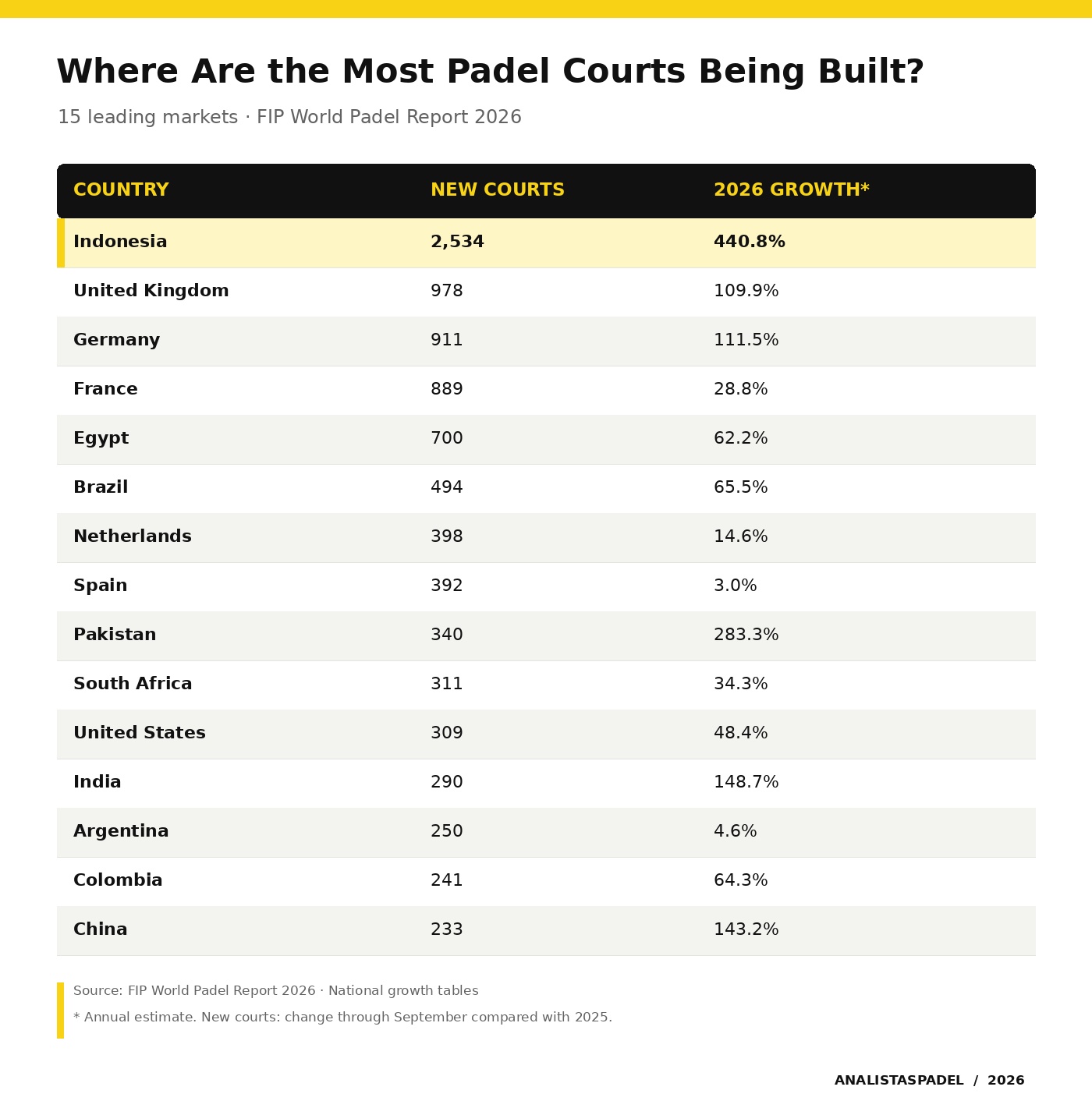
Indonesia combines the largest absolute increase with a projected growth rate of 440.8%. According to the FIP inventory, the country now has 3,300 courts and 1,100 clubs.
The report attributes part of Asia’s expansion to installation costs that are considerably lower than those in Western markets. In some countries, materials and labor can cost 70% to 80% less than in Europe, North America, or the Middle East.
Pakistan, India, and China are also recording substantial increases. Together, the three countries have added 863 courts, although their combined growth remains well below Indonesia’s.
Europe Continues to Build, but Growth Is Shifting Between Markets
Europe still has the world’s largest number of padel courts, with 56,981, representing approximately 62.5% of the global total. During the period analyzed, the continent added 5,881 courts.
Almost half of that increase came from the United Kingdom, Germany, and France, which together added 2,778 courts.
Germany’s growth is particularly notable. With 911 additional courts and a projected annual growth rate of 111.5%, the country now has more than 2,000 courts. The United Kingdom added 978 courts, bringing its total to 2,164.
France presents a different picture. Its market is considerably larger, with 5,000 courts, and continues to expand at an estimated annual rate of 28.8%.
The Netherlands is also maintaining substantial construction activity. It has added 398 courts and now has more than 4,000, overtaking Sweden in the global rankings.
Meanwhile, Spain and Italy, the two largest markets by total number of courts, are experiencing much more moderate growth.
Spain has 17,730 courts, an increase of 392 over the previous reference period. Italy has reached 10,375, adding 149 courts. The FIP estimates annual growth rates of 3% and 1.9%, respectively.
The situation is different in several smaller European markets. Ireland has added 219 courts, Ukraine 125, and Estonia 104. Their projected annual growth rates are 298%, 256.4%, and 192.6%, respectively.
Although their total numbers remain below those of Europe’s major markets, these countries are rapidly expanding their padel infrastructure.
Asia Now Accounts for Nearly One-Third of All New Courts Worldwide
The most pronounced shift is taking place in Asia.
The continent’s court count has risen from 4,633 to 9,026, an increase of 95% compared with the previous report. Indonesia accounts for approximately 58% of Asia’s new courts.
The geographic distribution is also changing. According to the FIP, the Middle East accounted for 89% of Asia’s courts in 2024, 72% in 2025, and 38% in 2026.
Saudi Arabia, the United Arab Emirates, Qatar, Kuwait, and Bahrain are now among the markets entering a consolidation phase, while growth is spreading across South and East Asia.
Thailand has added 84 courts, Malaysia 72, and Singapore 34. These figures are well below Indonesia’s, but they show how court construction is expanding into other countries across the region.
At the continental level, Europe continues to lead in the number of new courts, accounting for 42.4% of the global total. However, its share has fallen from 59.2% in the previous study. Asia’s share has increased from 10% to 31.7%.
Brazil and the United States Stand Out in the Americas, While Egypt Leads Africa
In the Americas, where the FIP records 20,259 courts, Brazil has registered the largest increase among the countries analyzed, adding 494 courts. Growth is spread across 16 states, with a projected annual rate of 65.5%.
The United States has added 309 courts and Colombia 241. Argentina, which retains the largest court inventory in the Americas with 7,450, has added 250. Mexico has recorded 166 new courts, bringing its total to 2,755.
Africa, meanwhile, has surpassed 4,700 courts after adding 1,343 compared with the previous report.
Egypt accounts for 700 of those new courts, reaching a total of 2,200. South Africa has added 311, bringing its total to 1,520. Together, the two countries account for more than 78% of Africa’s courts, according to FIP data.
Construction activity is also expanding in Morocco, which has added 78 courts, and in smaller markets such as the Democratic Republic of the Congo and Algeria.
Court Construction and Maintenance: An Estimated €1.312 Billion Market
The expansion of padel infrastructure also has a significant economic dimension.
For the first time, the FIP World Padel Report 2026 includes an analysis developed with OpenEconomics that estimates worldwide spending generated by different padel-related activities.
Court construction and maintenance account for an estimated €1.312 billion in 2026, divided between €746.2 million attributed to manufacturers and €565.8 million associated with local construction, installation, and maintenance work.
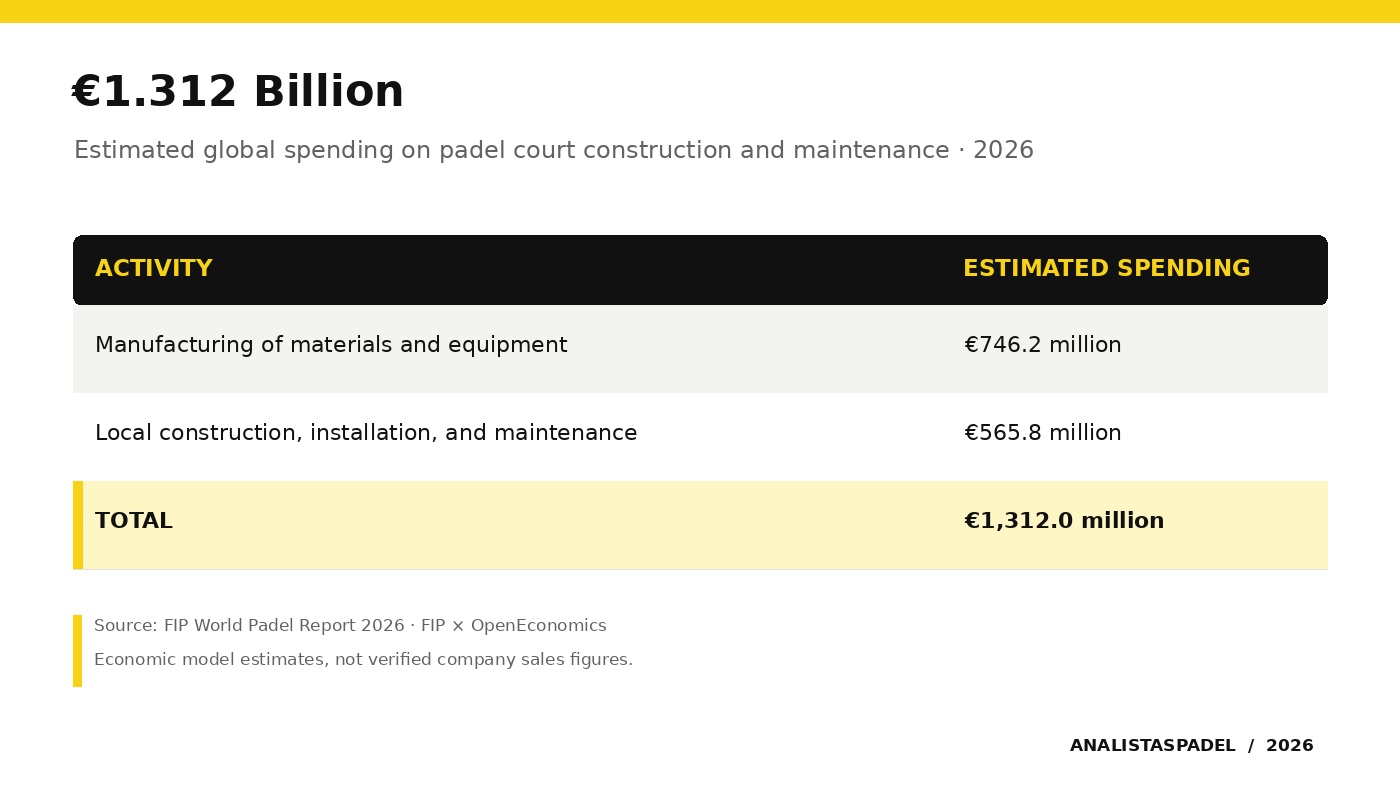
The economic model is based on a forecast of 14,618 new courts during 2026 and also accounts for facilities taken out of service. It projects 93,221 operational courts by year-end, a figure distinct from the 91,234 courts recorded in the August inventory.
Separating manufacturing from local construction makes it possible to distinguish spending attributed to the country where materials are produced from spending retained in the country where the court is installed.
For example, a court installed in Germany may generate business for companies manufacturing its components in other countries, as well as for the firms responsible for construction and installation.
Spain Leads Spending Attributed to Court Manufacturers
The report’s economic breakdown places Spain first in spending attributed to manufacturers, at €263.1 million. Italy ranks second with €100.4 million, followed by China with €98.2 million.
The ranking changes when looking at local construction and maintenance spending.
Germany records €79 million, the United Kingdom €64.8 million, and France €52.6 million. Indonesia reaches €48.3 million, while the United States accounts for €38.6 million.
These differences illustrate how activity is distributed internationally: some countries account for substantial volumes of new court construction, while others supply a significant share of the manufactured components.
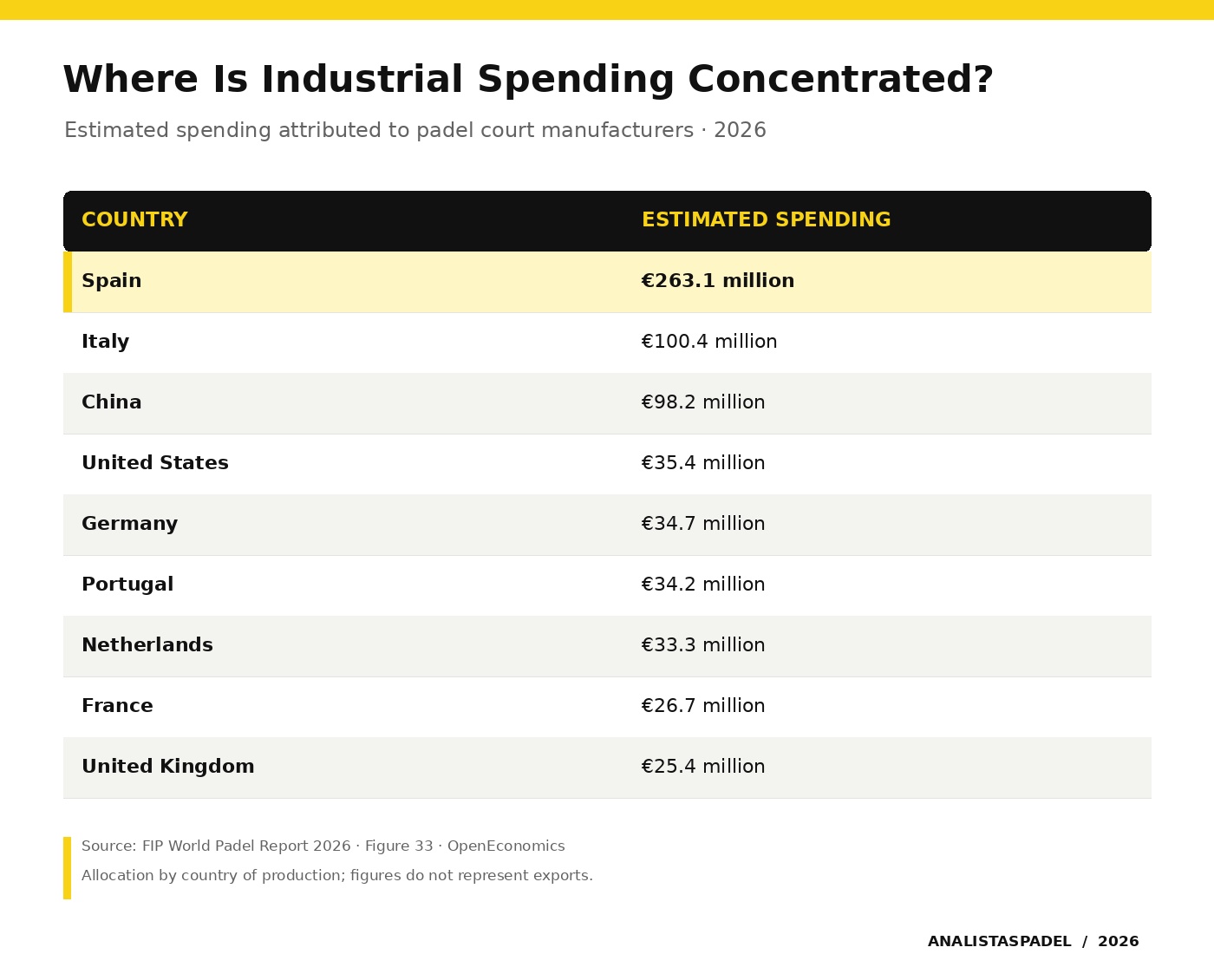
It is important to clarify that the amounts attributed to manufacturers are estimates produced by the economic model, based on FIP data and supplier records. They are not equivalent to actual company revenue and cannot be used to determine each country’s exports.
A Market Growing at Different Speeds
The international padel market is developing at markedly different rates.
Indonesia has recorded the largest increase in courts and leads Asia’s expansion. The United Kingdom, Germany, and France continue to see substantial construction activity in Europe, while Brazil, the United States, and Egypt rank among the leading growth markets in their respective continents.
Spain and Italy, despite more moderate increases in court numbers, retain the world’s largest court inventories. Spain also ranks first in spending attributed to manufacturers in the economic study.
The FIP World Padel Report 2026 identifies both the countries expanding their infrastructure and those to which the model attributes higher levels of industrial supply activity.
The development of manufacturers’ international sales will depend on how demand is divided between domestic and foreign suppliers, a distinction the report does not provide.